Tuesday, April 24, 2012

Tadashi Who?

Man of the Hour-Glass Mannequin (present company excepted) NYTimes photo by Jonathan Browning
Fashion plate is not a dish stacked in my china cabinet or clothes closet, for that matter. I’m not exactly the anti-fashion either. Let’s just say the leaves settled at the bottom of my post-shopping cup of tea spell out off the rack, not runway. Clearance rack, whenever possible.

I like the quality found in the limited and generic clothing stock of a warehouse store like Costco: Docker slacks, diggers, and shorts. Lee jeans. One-hundred per cent cotton tops. Better yet, tunics. Neutral toned. Clothes usually don’t add measurably nor take away from whatever impression I make.
<><><><><><><><><><><><><><><><> </> <><><><><><><><><><><><><><><><> </> <><><><><><><><><><><><><><><><> </>
Bride and MOTB (in her Tashi Shoji gown).
Yet, based on an article featured in the New York Times a few days agoFashion Section  even -- the  gown I wore to my daughter’s wedding (six months ago) bore the label of a trending designer. A guy at the top of his game who has dressed Oscars winners both before and after Em’s wedding. Hefty winners, referring to these ladies' talent and hip sizes..

Go figure.  Figure like in the pear-shaped dimensions I’ve sported since adolescence. More rump than rack, that’s for sure. Like the generic-ware at Costco: neither eye-catching nor eyesore. Presentable, like my mother use to say. Not necesssarily pretty.

Yet,  Tadashi Shoji, the designer of my dress - bought unused off  eBay -- is the same Tadashi Shoji who has become  The Man  of the Hourglass Mannequin. He has a knack for creating eveningware that smooths out lumps and bumps that shape most women to  an “illusion of tall and thin.” His words.

I wonder if it's too earlier to start trending a nomination for Time magazine’s  Person of the Year.

Saturday, April 7, 2012

Pane de Pasqua

This year's batch
For years, dare I say decades, I have associated Easter treats  with a sweet  bread more than a basketful of candy. As a newlywed – in the early Eighties, I came across a recipe for Pane de Pasqua in an Italian cookbook: Easter bread.  The half dozen pastel-colored  eggs braided through a wreath of golden-baked dough was what caught my eye.

I gave it a try.

The recipe listed a cup of sugar in the ingredients but never instructed when to add the sweetener, a misprint I guess.  I figured it should go  with the creamed butter, eggs, and juice from a squeezed lemon. The bread turned out pretty and light. Tasted like a bready  version  of  yellow  jellybeans  manufactured by Sweet Tarts, thanks to a glaze of confectionary sugar, fresh lemon juice, and milk drizzled on top.

This recipe has stuck with me through the years – with some alterations. After a few tries I split the wreath with the half-dozen eggs into two smaller braided loaves, three eggs decorating each. Made it easier to share between  two households, my parents’ , and Larry’s parents’. Both sides of the family considered it an Easter breakfast food more than a dessert. Perfect start to the day with a cup of strong black coffee. Morning leftovers reappeared on the mid-afternoon dessert table. Any leftover slices after that got double Saran-wrapped and popped into the freezer, readied for a couple more breakfasts.  

Through the years I’ve learned two lessons. First, bake it, unrushed,  a few days in advance, since it takes five to six hours . Most of that time goes to two dough risings – two hours each – as the initial ball of dough and then the braided ropes double in size. I guess that’s the resurrection part of the Easter bread. I’ve also learned to skip the tradition if Easter week becomes too hectic or my heart isn't committed to the process of beating, kneading, punching down, braiding and baking.I passed on it a number of times when my children were young and I worked full time  Skipped two years ago when my mother died on Palm Sunday. Picked up the tradition again last year and this year. Hope to introduce it to my new grandson  next year when he celebrates his first Easter, along with a mooshed up jelly bean or two.

Here’s the online recipe for the bread – with full instructions on when to add the sugar, plus a little Pane de Pasqua lore.

Thursday, April 5, 2012

Grandparents Get Named Too

My brother and I with Grandpa and Grandma D'Elia 1950
Last Christmas, I didn’t know I would become a grandmother later this year. Now, a few days before Easter, I do. Puts a different slant on a family holiday – winter or spring.

First, there’s the whole Easter Bunny thing. “Look what he left here,” I’ll be saying next year, to a baby, blissfully oblivious to the cause and effect connected to a basket of eggs, candied and hard-boiled. In time he will learn to anticipate the sweets and playthings that can fit in a tiny bushel. In more time, he may even roll his eyes at his grandmother’s proclivity towards overindulging him with treats. But then, what’s a Grammy for?

There, I said it: Grammy.

People want to know, you know. The way, pre-wedding,  they wanted to know what my future son-in-law would call me, they want to know what Patrick Lawrence will call me, his Mom’s Mom, when we are grandmother and grandson. I remember when someone asked my dad that, near forty years ago. His son was about to become a father. Dad answered, “Mr. Baione.” He was going for a laugh. Elicited a few raised eyebrows too. In seemingly no time, he became Grandpa Baione to each of my brother’s four children. The same four who dubbed my mom “Grammy” through their child and adulthoods.

These revered designations carried on when my daughter and son were born – sort of. Em certainly took the cue from her older cousins, but when the now, mommy-to-be, tried to repeat her cousins’ term of endearment for my mother,  she forsook the first syllable and double-stated the second. Thus Grammy became Mimi to my daughter and son.

What will my grandson call me?

Whatever he wants.


Sunday, April 1, 2012

What's in a Name? Revisited

Baby-to-Be is a boy. No question about his name either.

Patrick Lawrence.

Dad-to-Be has always been partial to Patrick. A strong Irish name, he says. Unprecedented on his side of the family.

And I don’t think there was ever a doubt this tyke’s moniker would, in some way, honor Larry, his Mom’s deceased father.

Patrick Lawrence. “Nobleman of Laurentis,” when you merge the meanings of the two names.

Come to think of it, his middle name plays off of Grammy-to-Be’s too. As husband-and-wife, I was Laura-and-Larry.  As sister-and-brother, I am Laura-and-Larry. Both of which contributed to  why my son was not named Larry. Those along with two other contributions: Uncle Larry and Great Uncle Larry on Larry’s side of the family.

 “Too many Larry’s,” I can still hear him saying when I suggested our son be a Larry Jr.

My parents back peddled a bit on the choice of my name too. I was supposed to be Rose, after my father’s mother, if I was a girl or Laurence, after his father, if I was a boy. When I surprised all – by being immediately followed by a twin brother, my parents resorted to two twin-names alternatives: Laurence and Laura or Rose and Rosario. My twin brother may be even more grateful than I am for the choice they made. Shakespeare may have said “ a  rose by any other name would smell as sweet,” but I’m not sure he'd say the same holds true for a Rosario.

Sunday, March 25, 2012

Choice Words

When the elated Mother-to-Be, Father-to-Be, and Grammy-to-Be let go from their embrace, they thought, almost simultaneously, Uncle-to-Be must be called. Uncle-to-Be as in Brother-of-the-Bride. Eloquent Toastmaster of rehearsed extemporaneous-ness.

Uncle-to-Be was one hundred miles away. What better opportunity to initiate a Face Time call? We’d get to hear and see his reaction, in iPhone video motion. I expected a single raised eyebrow – reminiscient of his Dad’s -- would punctuate his facial expression. A complement to well chosen words of congratulations.

We sent the Face-Time request, iPhone to iPhone. But BOTB was at work at a fitness center. Face-to-face group talk? Out of the question. BOTB could not talk at all.  He could only text a quick reply, a clandestine sweep of thumbs over keyboard, between one fitness-center-chore and another:

can’t talk now.

David Kilper/WUSTL Photo
We three were disappointed but not deterred. “Send him the picture,” I suggested. Father-to-Be switched his iPhone to camera application and focused in on the monochromatic photo on the table. The photo that had been the message in the baby bottle. If you stared at the picture long enough, it looked like Casper the Ghost, cradled in an infant rocker.

 Father-to-Be added a text to the photogram, “Hi Uncle,” and tapped Send.

The message took off with a swoosh. Within seconds the tri-tone of an incoming text bubbled. And Uncle-to-Be’s response lay before us.

A response to which I immediately thought  It'll  be a very  l o n g  time before the baby gets to hear that!


Sunday, March 18, 2012

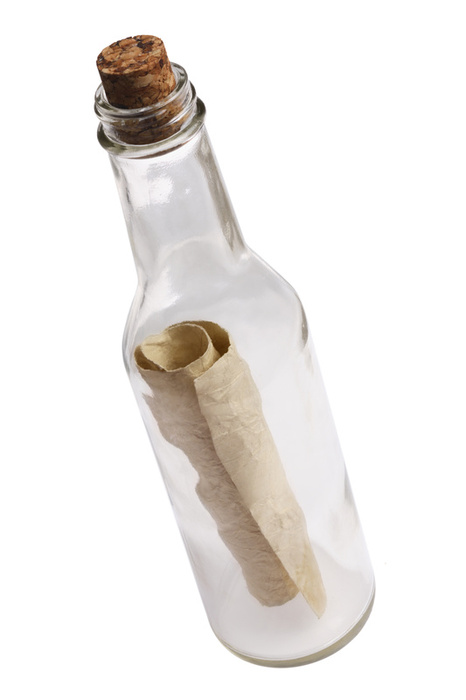
Message in a Bottle


Photo by Shutterstock
 

It’s been quite a ride for the Mommy of the Bride.

Almost six months ago, the wedding tick-tocked by with the precision of a fine Swiss clock. Around the same time, MOTB’s memoir was published; an event the Brother-of-the-Bride worked unabashedly into his toast .

It was all good.

Through the next month or two the bride and groom settled in as Mr. and Mrs. There followed a First Thanksgiving, split between two households. Then a First Christmas, also celebrated here and then there. As hard as they try, even newlyweds cannot be two places at once.
The memoir officially launched in the New Year - at a local reading packed with family, friends, and interested town folk.  The groom, unable to attend the reading, visited the MOTB with his bride a few days afterward – bearing a bright green gift bag.

 He was all congratulations and apologies.

MOTB was all understanding. She has often wished she could be here and there, simultaneously, too.

 But a gift?

“You didn’t have to. Unnecessary, “she insisted, about to add, “I don’t need anything,” as she separated sheets of pastel tissue paper from an oddly shaped object. Long. Cylindrical, Tapered at the top.

A bottle?  With a rolled up message!

“No.!” Additional words would not come.
“Yes!”

The pair was all smiles.
The three were all hugs.
All good is getting better.

SAVE 20% DIGITIZING YOUR MEMORIES WITH iMEMORIES

Wednesday, March 14, 2012

Writing it Forward

Article  by Laura B. Hayden first published as Prolonged Grief Increases Young Widows' Health Risks on Technorati  on March 11, 2012.

Thirteen years ago I read a letter to an editor urging young widows to go for annual physicals. The timing of the piece reminded me of when I first read about the Heimlich Maneuver in 1974, just days after my grandfather choked to death on a bite of meat.
My uncle had rushed to Grandpa’s aid, pounding on his back to dislodge the piece of meat – all to no avail. If he had known enough to wrap his arms just above Grandpa’s waist, and pull into his gut, the morsel would have popped out and my grandfather would have survived.

The letter in the newspaper that advocated regular physical exams for young widows jolted me once again, for my 49-year-old husband had died a few weeks earlier
.
One third of the 800,000 people widowed every year are under age 45. And when the death is sudden, as with my young husband's, the effects on the surviving spouse can be particularly severe and long lasting. Unlike older widows, young widows face the greater part of their lives before them. This puts the younger woman who has lost her husband at greater risk for long-term emotional and physical effects of grief.

GRIEF WRECKS A PHYSICAL AS WELL AS EMOTIONAL TOLL

A year ago, the medical community officially declared a broken heart can actually trigger a heart attack. “Emotional stress, conceptionally, is the same thing for cardiovascular risk as physical stress,” says Daniel J.Brotman MD of John Hopkins Hospital. “But a lot of doctors blow that off, because they think emotional stress is a psychological problem, not a physical one.”

When I lost my husband, twelve years ago, my doctor recognized I was in for the long haul. He immediately began monitoring my inevitable symptoms of grief: depression, exhaustion, nervousness, loss of appetite, insomnia, weakness, and aching. New evidence in the 1990s had indicated that grief and its related stress affect young widows more seriously than women who lose their husbands later in life. - because of the longer period of time the younger bereaved would likely experience elevated blood pressure, unhealthful eating habits, and weakened immune systems.

Just after my husband's death the doctor found my blood pressure elevated and he was concerned about my ten-pound weight loss – an outcome friends actually complimented me on – since the short time my husband had died. My doctor also wasn’t surprised I cried during the appointment.

Like most people, I did not feel a rise in my blood pressure. My weight loss certainly didn’t bother me, and I expected I’d be sad for a very long time. Yet, if these symptoms of grief went untreated for an extended period of time – which could be four or five decades for a young widow – unnoticed and insidious damage could escalate. Ultimately it would reveal itself in a critical episode, like a heart attack or a late-stage cancer.
None of my early symptoms of grief called for drastic measures. Yet, my doctor scheduled me for regular blood pressure checks and recommended the children and I see a grief counselor. I followed doctor’s orders through the next annual physical. My weight and blood pressured stabilized. I still grieved, but my physical reactions to my grief were being monitored. The same went for the next year and the one after that.

EARLY DETECTION CAN BE A MATTER OF LIFE OR DEATH

Five years after my husband died I still grieved but I felt fine, physically. I expected to go to my annual exam and not have to see the doctor again for a year. Instead, I got a phone call the day after my appointment.
“There’s blood in your urine and your liver function is off,” he told me on the phone. “We’ve got to find out why.”

I soon learned my "feeling fine" had been deceptive. The next day a tumor the size of my fist appeared atop my right kidney on an ultrasound screen. There had been no pain, no bleeding perceptible to the eye (just microscopic blood cells in my urine sample on the day of my physical), and no palpable lump.

An MRI followed. Then a diagnosis: Late Stage Two kidney cancer. Since I had no risk factors for kidney cancer, my doctor said the high stress I had experienced through five years of grieving could have had a connection to my cancer diagnosis."Possible but not provable," was the way he put it.Yet, I was fortunate. Within weeks, major surgery removed the tumor and kidney - before the cancer had spread. My lymph nodes were clean.

REMAIN VIGILANT AGAINST THE EFFECTS OF PROLONGED GRIEF

Every year, at my annual physical, I still tell my doctor how thankful I am to have found the letter to an editor advocating regular physicals for widows – especially young widows.

“Early detection,” my doctor replies. “Prevention is the way to go.” He doesn’t stop there. “Any loss can have negative cardiac consequences or weaken resistance.” I understand what he is saying. Dealing with a death, a divorce, a loss of a job –all of these create the added stress that can weaken the body and its defense against disease.

Even as a widow I have been lucky in a number of ways. Thirteen years ago, a piece in the morning paper got me to see a doctor in the first place. Then that doctor treated me for silent precursors of heart disease. Five years later, a routine exam detected cancer in an early, curable stage.

I wonder what would have happened if I didn't start seeing a doctor regularly after my husband's death. I am grateful I came across that letter to an editor. I'd like to write it forward.